For ml researchers and fine-tuning developers
Isolate motherboard PCIe P2P restrictions and /dev/shm limits on Vast.ai hosts.
Verify IOMMU peer-to-peer memory access, Docker shared memory allocation, and spot instance preemption markers before blaming model code on heterogeneous Vast.ai rigs.
Free 30-day Team evaluation. No card or automatic subscription. Work email verification required.
Replay a resolved Vast.ai multi-GPU crash incident
Upload your log file. Review the selected evidence and masking, then run diagnosis. Keep the original log for any follow-up questions.
Before uploading, review cloud data handling and local options.
Upload your log file. Large files are processed in your browser. Only selected evidence is submitted when you run diagnosis.
Try Denpex for 30 days. FREE.
No credit card. No automatic subscription. See whether Denpex helps with an incident you already understand.
Start your free 30-day Team evaluation
Up to 50 diagnoses a day for 30 days. Verify your work email to activate an eligible company evaluation, then replay a resolved incident and compare the evidence and next steps with your team's confirmed cause.
What a useful evaluation should establish
Establish whether the failure stems from host motherboard topology limitations or a container configuration gap that can be resolved with environment flags.
Use Denpex alongside your existing telemetry tools to investigate submitted incident evidence. With monitoring configured on a supported plan, detected failures can trigger alerts and an automatic diagnosis from the captured evidence.
Inside Denpex
See the evidence, not just the claim
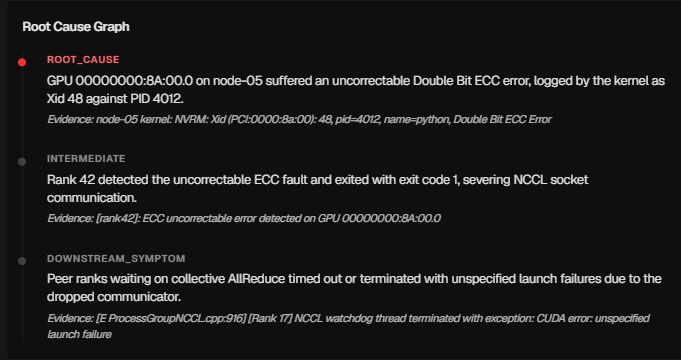
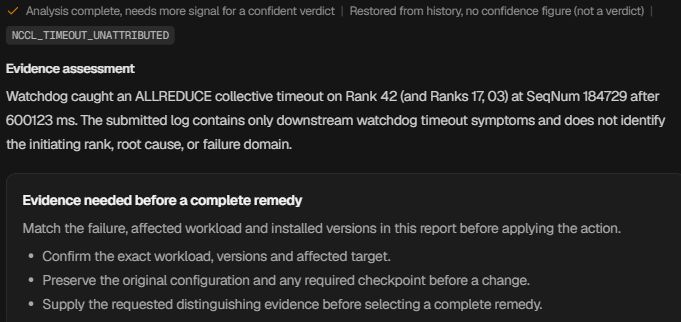
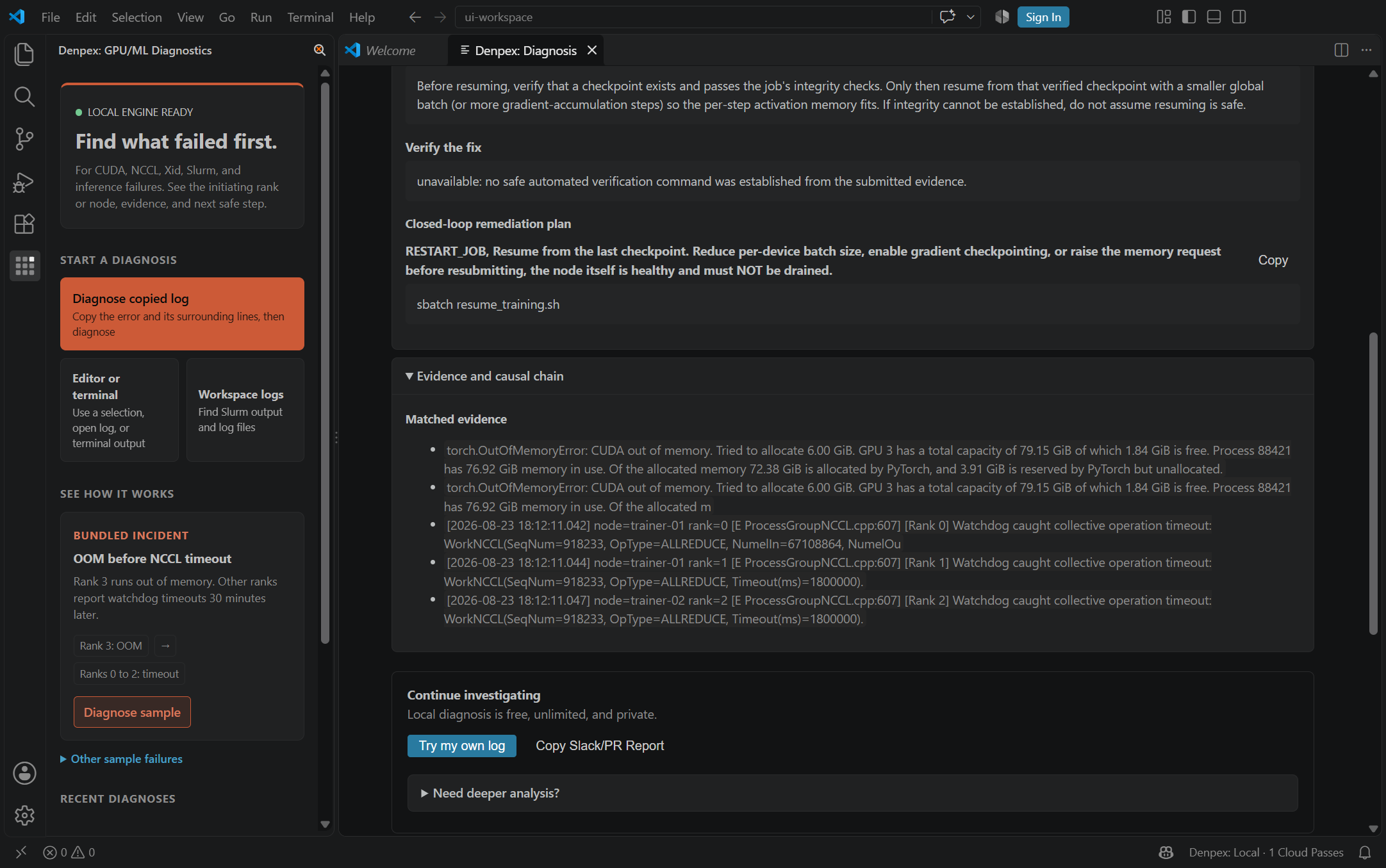
Follow the causal chain, inspect the quoted evidence and prepare the next handoff. These actual product captures use founder-account examples and the VS Code extension, with the source identified under each image. Open a capture to inspect it at full size.
Follow the failure through the cascade
Prepare the hardware escalation

Ask for the evidence that is missing
Keep the investigation in the editor
Vast.ai - Observed Runtime Evidence
Incident pattern summary
A 4x RTX 4090 instance on Vast.ai crashes immediately on torch.distributed.init_process_group with ncclUnhandledSystemError. The log trace points to failed P2P CUDA IPC mapping across consumer motherboard PCIe switches, resolved by testing NCCL_P2P_DISABLE=1 or migrating hosts.
vast-instance-8912:88:104 [1] NCCL WARN Cuda failure 'peer access is not supported between these two devices'
vast-instance-8912:88:104 [1] init.cc:902 NCCL WARN initTransportsRank: P2P initialization failed
torch.distributed.DistBackendError: NCCL error in: ../torch/csrc/distributed/c10d/ProcessGroupNCCL.cpp:1275, unhandled system error, NCCL version 2.19.3
Recommended verification flags
Set these environment flags in your training container or launch script to capture high-resolution collective logs:
NCCL_P2P_DISABLE=1NCCL_SHM_DISABLE=0NCCL_DEBUG=INFOCUDA_LAUNCH_BLOCKING=1Diagnostic Scope Boundary
Denpex cannot modify host BIOS IOMMU settings or prevent marketplace host reclamation on Vast.ai. The diagnosis clarifies whether a crash requires environment workarounds or immediate instance replacement.
Other GPU Cloud Failure Workflows
Compare evidence patterns across multi-node fabrics, Kubernetes pods, and bare-metal environments.