For decentralized compute users and distributed ml practitioners
Untangle NAT port forwarding and c10d rendezvous timeouts on TensorDock VMs.
Verify whether torchrun workers failed during initial TCPStore handshake, ephemeral port negotiation, or KVM hypervisor PCIe passthrough resets.
Free 30-day Team evaluation. No card or automatic subscription. Work email verification required.
Replay a resolved TensorDock multi-node incident
Upload your log file. Review the selected evidence and masking, then run diagnosis. Keep the original log for any follow-up questions.
Before uploading, review cloud data handling and local options.
Upload your log file. Large files are processed in your browser. Only selected evidence is submitted when you run diagnosis.
Try Denpex for 30 days. FREE.
No credit card. No automatic subscription. See whether Denpex helps with an incident you already understand.
Start your free 30-day Team evaluation
Up to 50 diagnoses a day for 30 days. Verify your work email to activate an eligible company evaluation, then replay a resolved incident and compare the evidence and next steps with your team's confirmed cause.
What a useful evaluation should establish
Establish whether network rendezvous failed at the initial port-forwarding layer or during dynamic NCCL socket peer exchange.
Use Denpex alongside your existing telemetry tools to investigate submitted incident evidence. With monitoring configured on a supported plan, detected failures can trigger alerts and an automatic diagnosis from the captured evidence.
Inside Denpex
See the evidence, not just the claim
Follow the causal chain, inspect the quoted evidence and prepare the next handoff. These actual product captures use founder-account examples and the VS Code extension, with the source identified under each image. Open a capture to inspect it at full size.
Follow the failure through the cascade
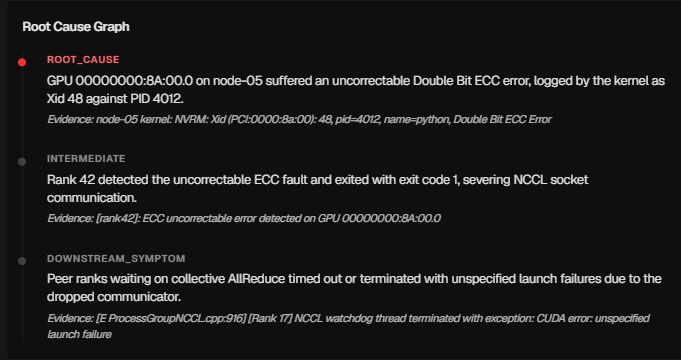
Prepare the hardware escalation

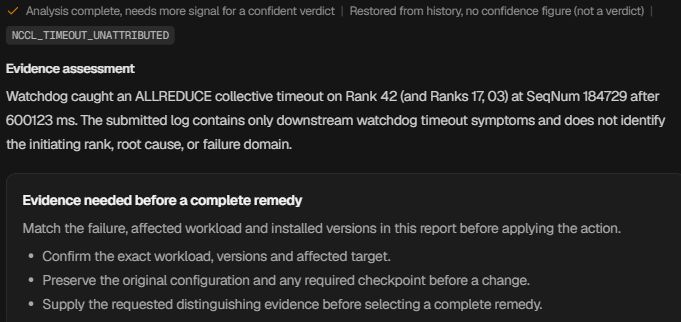
Ask for the evidence that is missing
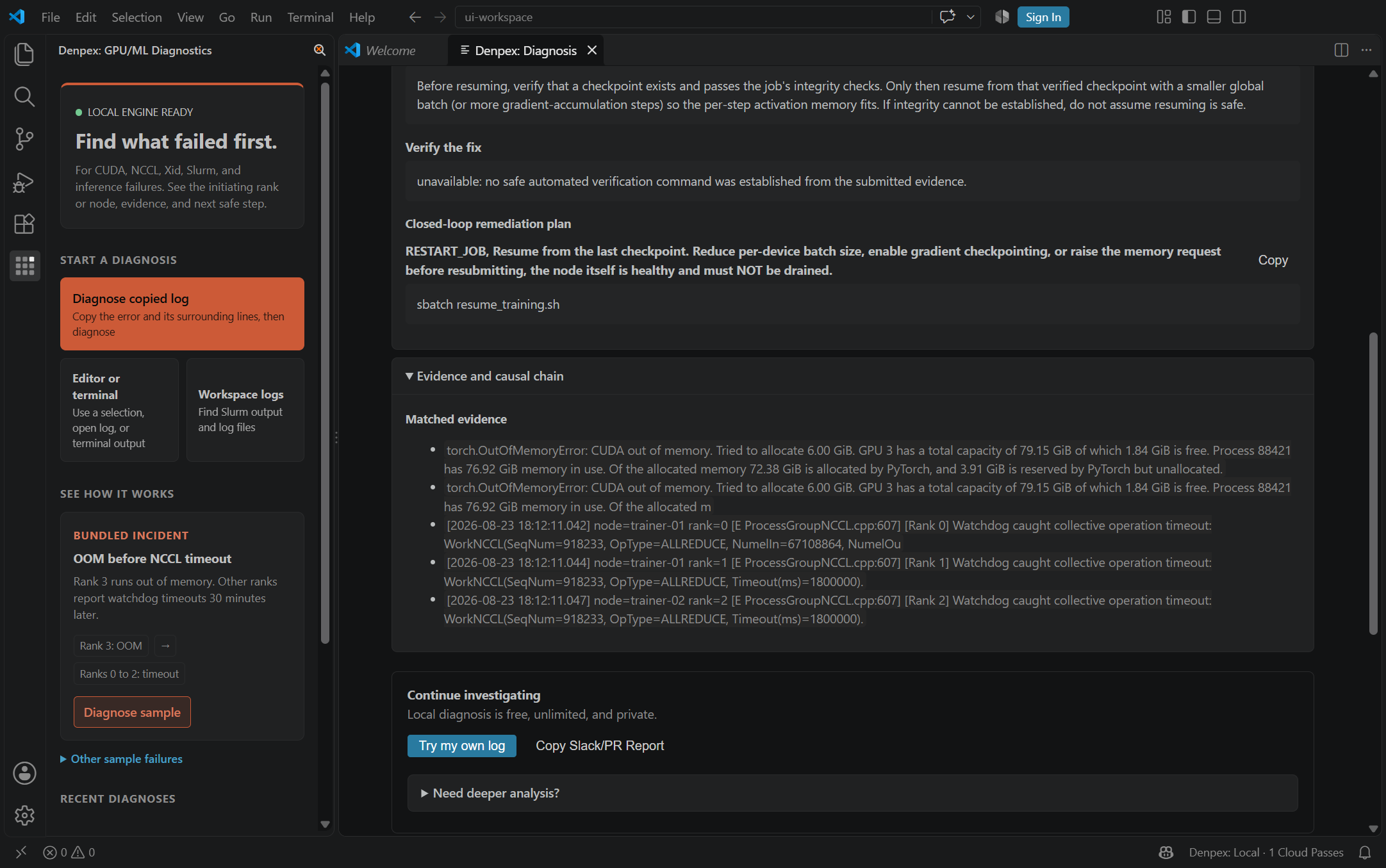
Keep the investigation in the editor
TensorDock - Observed Runtime Evidence
Incident pattern summary
A distributed job across two TensorDock VMs passes the MASTER_PORT=29500 TCPStore handshake, then fails 60 seconds later with NCCL socket connection refused. Because NCCL opens dynamic ephemeral ports outside the forwarded port range, workers cannot establish direct data rings without an overlay mesh or dedicated public IP.
[E socket.cpp:957] [c10d] The client socket has timed out after 600s while trying to connect to (203.0.113.45, 29500).
torch.distributed.DistNetworkError: The client socket has timed out after 600s while trying to connect to (203.0.113.45, 29500).
tensordock-vm-2:1092:1108 [0] NCCL WARN Connect to 192.168.122.14<38912> failed : No route to host
Recommended verification flags
Set these environment flags in your training container or launch script to capture high-resolution collective logs:
NCCL_DEBUG=INFONCCL_SOCKET_IFNAME=wg0NCCL_IB_DISABLE=1TORCH_CPP_LOG_LEVEL=INFODiagnostic Scope Boundary
Denpex cannot provision dedicated IPv4 addresses or configure WireGuard tunnels on TensorDock instances. The evaluation pinpoints the exact network layer where multi-node communication broke down.
Other GPU Cloud Failure Workflows
Compare evidence patterns across multi-node fabrics, Kubernetes pods, and bare-metal environments.