For manifold bio infrastructure and model engineering teams
Manifold Bio design run: runtime failure or experimental outcome?
Compare approved model-worker exceptions with input and output artifact boundaries. Keep computational reliability separate from measured biological performance.
Free 30-day Team evaluation. No card or automatic subscription. Work email verification required.
Replay a resolved Manifold Bio workflow incident
Upload your log file. Review the selected evidence and masking, then run diagnosis. Keep the original log for any follow-up questions.
Before uploading, review cloud data handling and local options.
Upload your log file. Large files are processed in your browser. Only selected evidence is submitted when you run diagnosis.
Try Denpex for 30 days. FREE.
No credit card. No automatic subscription. See whether Denpex helps with an incident you already understand.
Start your free 30-day Team evaluation
Up to 50 diagnoses a day for 30 days. Verify your work email to activate an eligible company evaluation, then replay a resolved incident and compare the evidence and next steps with your team's confirmed cause.
What a useful evaluation should establish
Compare one incident your team has already resolved with the first failure, quoted evidence and remaining questions. Begin with this question: Did the computational worker terminate before exporting results? Only assign a process, device or recovery state when the submitted evidence establishes it.
Did the computational worker terminate before exporting results?
Evidence to compare: Approved process exit, first runtime exception and output-write completion.
An incomplete computational run needs runtime evidence. A completed run with an unfavorable experimental result is a different issue and must not be labeled a GPU fault.
Were the expected input and model artifacts available?
Evidence to compare: Redacted artifact identifiers, load completion and the first input-read error.
A missing or mismatched artifact can fail the pipeline before inference begins. Establish that boundary without requesting proprietary sequences or experiment contents.
Is this the published workflow or a different internal pipeline?
Evidence to compare: Model revision, approved execution-stage description and confirmed incident outcome.
The public collaboration establishes context, not private architecture. Keep unknown infrastructure and experimental conclusions outside the diagnosis until evidence supports them.
Use Denpex alongside your existing telemetry tools to investigate submitted incident evidence. With monitoring configured on a supported plan, detected failures can trigger alerts and an automatic diagnosis from the captured evidence.
Inside Denpex
See the evidence, not just the claim
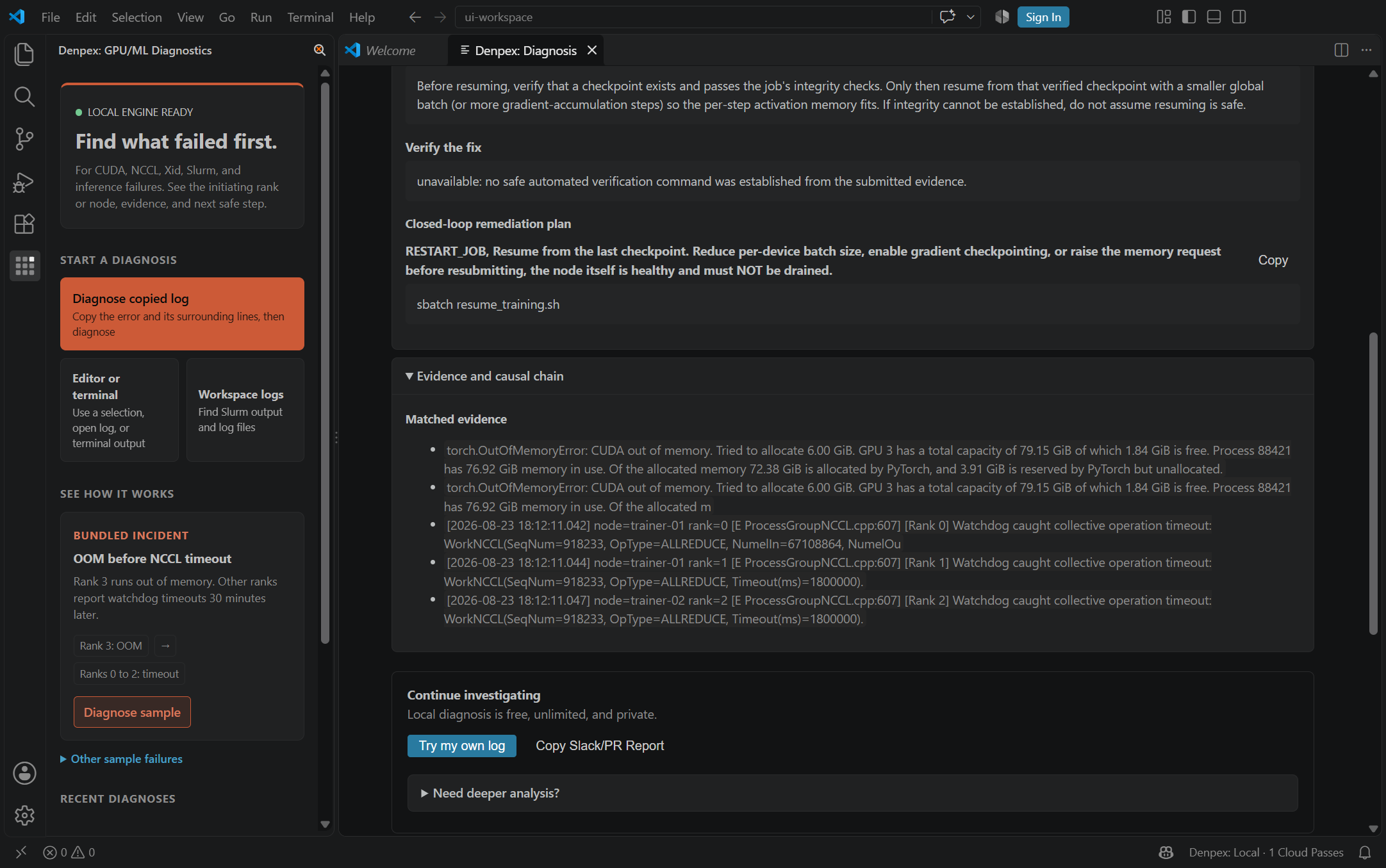
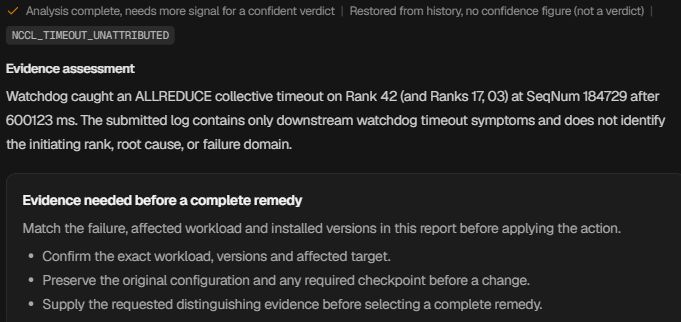
Follow the causal chain, inspect the quoted evidence and prepare the next handoff. These actual product captures use founder-account examples and the VS Code extension, with the source identified under each image. Open a capture to inspect it at full size.
Follow the failure through the cascade
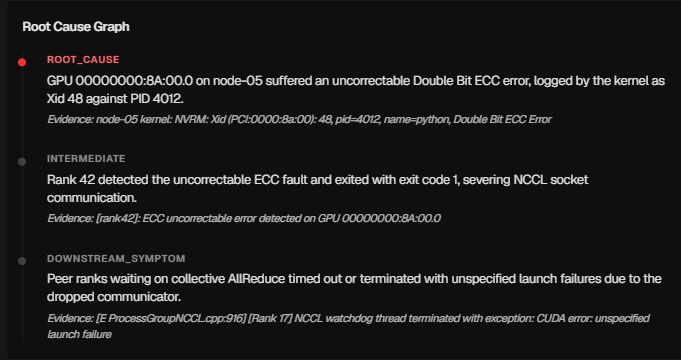
Prepare the hardware escalation

Ask for the evidence that is missing
Keep the investigation in the editor